
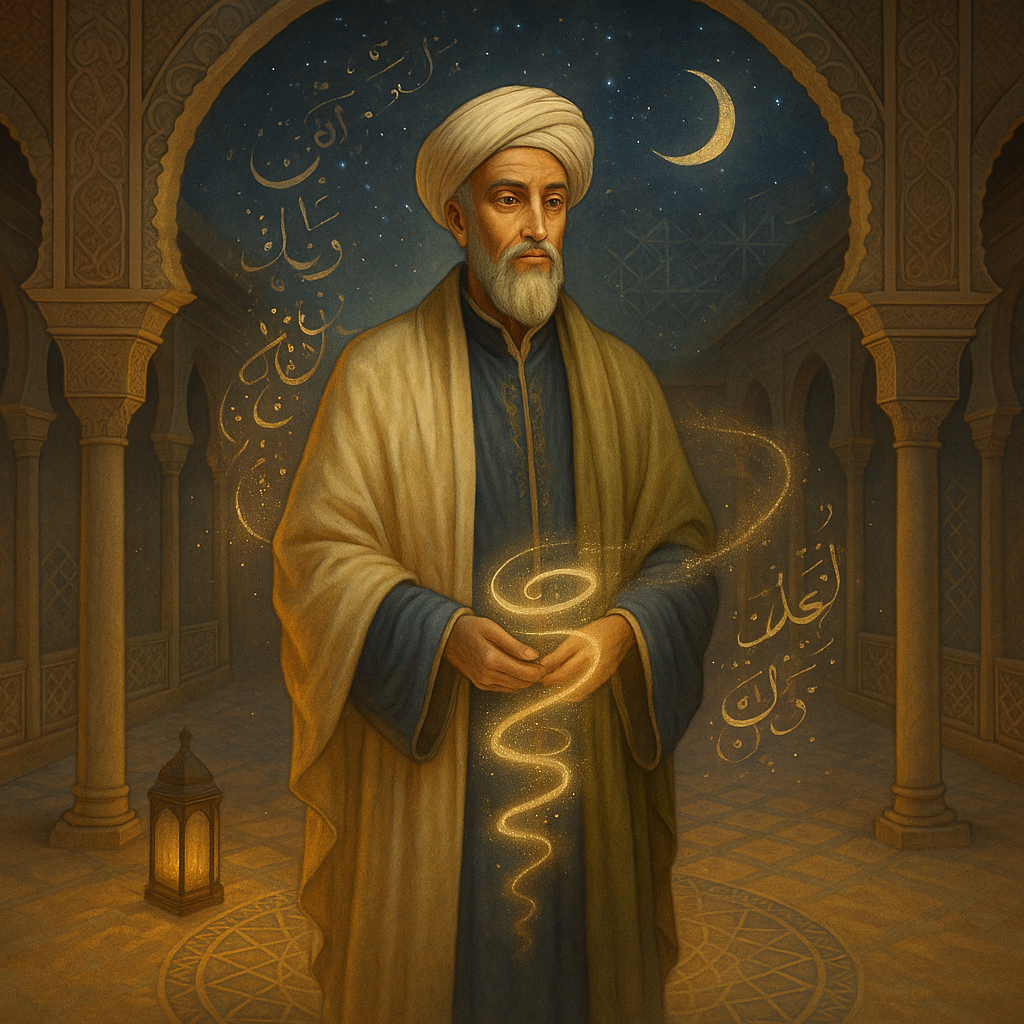
Overview
Ibn Arabi (1165–1240 CE), often called al-Shaykh al-Akbar (“The Greatest Master”), was a highly influential Sufi mystic, Islamic philosopher, poet, and metaphysician. His vast body of work explores divine unity, spiritual realization, cosmology, and the mystical dimensions of human existence. Revered across spiritual traditions, he shaped the intellectual and esoteric foundations of Sufism for centuries.
Historical Background
Early Life
- Born in Murcia, Al-Andalus (modern-day Spain)
- Raised in a culturally rich, multi-faith environment
- Experienced profound spiritual visions from a young age
Spiritual Development
- Studied Islamic jurisprudence, theology, and philosophy
- Met prominent scholars, mystics, poets, and Sufi masters
- Initiated into several Sufi orders and deepened contemplative practice
Travels and Teaching
- Traveled through North Africa, Mecca, Anatolia, and the Middle East
- Shared teachings with scholars, rulers, and spiritual seekers
- Settled in Damascus, where he taught and wrote until his passing
Core Teachings and Philosophy
Unity of Being (Wahdat al-Wujud)
- All existence is a manifestation of one divine reality
- Creation reflects the Names and Attributes of God
- Separation is an illusion—unity is the true foundation of being
The Perfect Human (al-Insan al-Kamil)
- Humans have the unique capacity to mirror divine qualities
- The spiritually realized person becomes a bridge between heaven and earth
- Self-knowledge leads to recognition of God within
Divine Love and Knowing
- Love is the animating force of the universe
- True knowledge arises from inner unveiling (kashf), not intellect alone
- The heart is the organ of spiritual perception
Cosmology and Metaphysics
The Imaginal Realm (Alam al-Mithal)
- Intermediate dimension between physical and spiritual worlds
- Home to archetypes, symbols, visions, and dreams
- Essential for understanding revelation and mystical experience
Manifestation and Creation
- The universe unfolds continuously through divine self-disclosure (tajalli)
- Every being has spiritual significance and purpose
- Existence is a dynamic dialogue between Creator and creation
Major Works
The Meccan Revelations (Al-Futuhat al-Makkiyya)
- Encyclopedic spiritual manual
- Covers cosmology, mystical psychology, theology, ethics, and practice
The Bezels of Wisdom (Fusus al-Hikam)
- Explores divine wisdom expressed through prophetic figures
- Central text for understanding his metaphysical system
Poetry and Spiritual Literature
- Thousands of poems conveying mystical love, longing, and union
- Symbolic, experiential, and metaphoric language
Influence and Legacy
Impact on Sufism
- Became a foundational thinker for later Sufi philosophy
- Inspired commentaries, schools of metaphysics, and contemplative practices
Global and Cross-Cultural Reach
- Influenced Islamic scholars, Christian mystics, philosophers, and poets
- Continues to shape comparative religion, psychology, and metaphysics
Controversy and Debate
- Teachings on divine unity challenged literalist interpretations
- Defended by mystics and philosophers who recognized symbolic intent
Metaphysical and Esoteric Perspectives
Inner Realization
- Awakening requires purification, remembrance, surrender, and heart-centered awareness
- Every soul has a unique spiritual path and divine imprint
Symbolic and Mystical Language
- Paradox, poetry, and metaphor express truths beyond rational limits
- Spiritual knowledge requires contemplation, humility, and intuition
Key Symbols and Associations
Spiritual Symbolism
- The Heart: gateway to divine knowledge
- The Ocean and Wave: unity within multiplicity
- Mirror: creation reflecting divine essence
- The Perfect Human: harmonized spiritual potential
Ibn Arabi remains a luminous guide in the world of mysticism—inviting seekers to recognize the sacred unity within themselves, all beings, and the unfolding universe. His teachings offer a timeless pathway toward love, wisdom, and experiential connection with the Divine.