
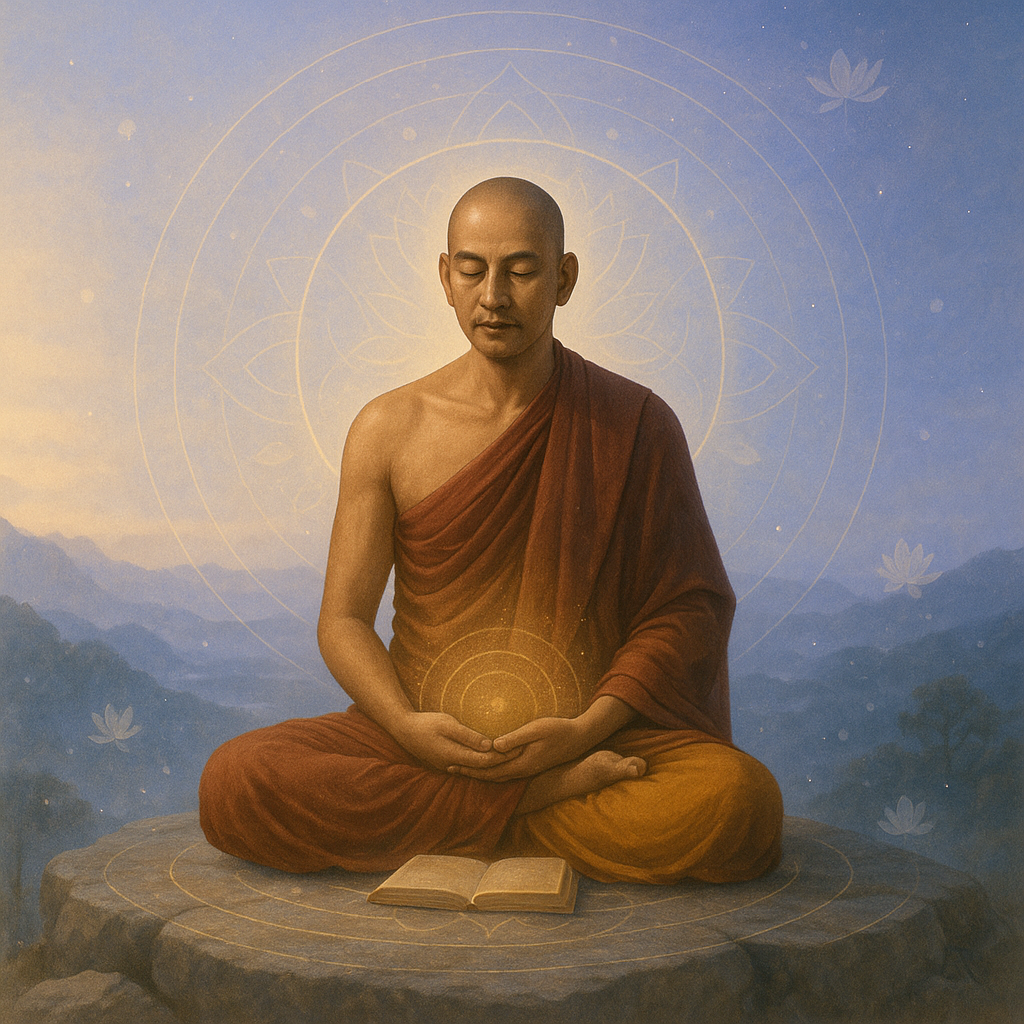
Overview
Nagarjuna (c. 150–250 CE) was an Indian Buddhist monk, philosopher, and foundational thinker of the Mahayana tradition. Revered as the “Second Buddha” in some lineages, he developed the Madhyamaka (Middle Way) philosophy, which teaches śūnyatā—the profound emptiness of inherent existence. His writings reshaped Buddhist thought by emphasizing wisdom, compassion, and the interdependent nature of reality.
Historical Background
Life and Origins
- Born in South India, likely into a Brahmin family
- Converted to Buddhism and joined the monastic community
- Studied early Buddhist teachings, logic, and philosophy
- Traveled widely, engaging in spiritual debate and scholarly dialogue
Association with Nalanda
- Often linked to the great monastic university of Nalanda
- Influenced generations of Buddhist scholars, practitioners, and educators
- Helped systematize Mahayana philosophy
Core Teachings and Philosophy
Emptiness (Śūnyatā)
- All phenomena lack inherent, independent existence
- Things arise through causes, conditions, and relationships
- Emptiness is not nihilism—rather, it affirms interconnectedness
Dependent Origination (Pratītyasamutpāda)
- Nothing exists in isolation
- Reality is a dynamic web of causes and effects
- Wisdom arises from understanding relational existence
The Middle Way
- Avoids extremes of eternalism (permanent essence) and nihilism (nonexistence)
- Recognizes reality as fluid, conditioned, and experiential
- Encourages compassionate, non-dogmatic living
Major Works
Mūlamadhyamakakārikā (Fundamental Verses of the Middle Way)
- Nagarjuna’s most influential text
- Uses reasoning to reveal the illusory nature of fixed concepts
- Explores perception, identity, causation, and liberation
Letters and Treatises
- Writings to kings and disciples offering ethical and spiritual guidance
- Blend philosophical insight with practical compassion
The Two Truths Doctrine
Conventional Truth
- Everyday reality—language, identity, experience
- Functional and necessary for communication and moral action
Ultimate Truth
- No fixed, independent essence behind phenomena
- Directly realized through meditative insight
Nagarjuna taught that understanding both truths leads to awakening.
Impact on Buddhism
Mahayana Development
- Provided philosophical foundation for later schools—Tibetan Buddhism, Zen, and Chan
- Clarified the Bodhisattva path of wisdom and compassion
Debate and Scholarship
- Influenced Buddhist logic, epistemology, psychology, and ethics
- Engaged scholars across Asia for centuries
Metaphysical and Spiritual Insights
Liberation Through Wisdom
- Suffering arises from attachment to fixed beliefs and identities
- Realizing emptiness dissolves fear, ego, and grasping
Compassion as Natural Response
- Interdependence reveals shared existence
- Caring for others becomes an expression of awakened awareness
Deconstruction of Concepts
- Encourages humility, curiosity, and direct experience
- Truth cannot be captured fully by language or ideology
Legacy and Continuing Influence
Global Philosophical Impact
- Studied by philosophers, psychologists, scientists, and interfaith scholars
- Resonates with modern systems theory, quantum physics, and cognitive science
Spiritual Relevance
- Guide for meditation, mindfulness, and nondual awareness
- Offers tools for navigating uncertainty, conflict, and identity
Key Symbols and Associations
Spiritual Symbolism
- The Middle Way Path: balance, clarity, freedom from extremes
- Open Space or Sky: emptiness, boundlessness, possibility
- Lotus in Water: conditioned existence and arising from causes
- Interdependent Web: relational reality and shared being
Nagarjuna remains a profound voice in Buddhist philosophy—inviting seekers to look beyond rigid assumptions, embrace interdependence, and discover liberation through wisdom, compassion, and direct experience of reality as it truly is.