
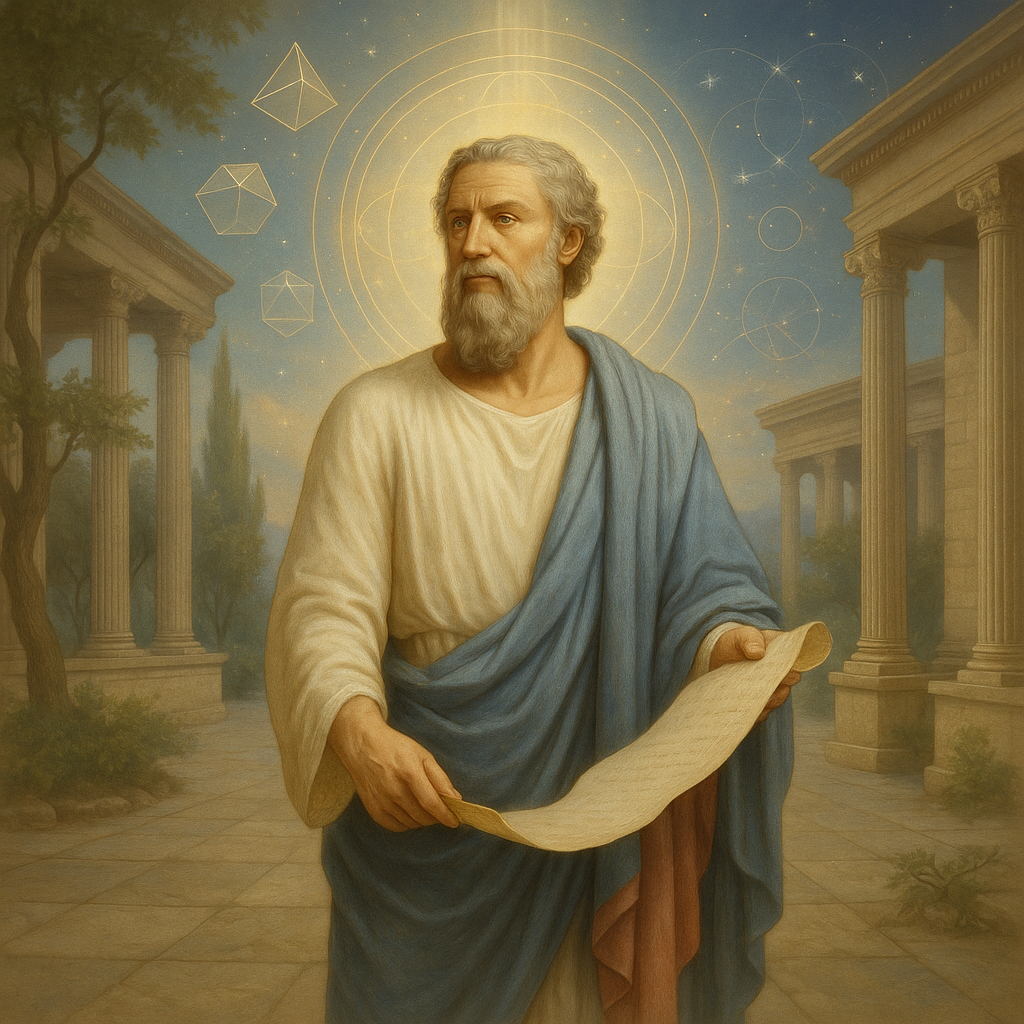
Overview
Plato (c. 428–348 BCE) was an ancient Greek philosopher, student of Socrates, teacher of Aristotle, and founder of the Academy—the first institution of higher learning in the Western world. His dialogues explored ethics, metaphysics, politics, epistemology, psychology, and the nature of reality. Known for the Theory of Forms, he remains one of the most influential thinkers in human history, shaping philosophy, education, spirituality, and Western intellectual tradition.
Historical Background
Early Life and Influences
- Born into an aristocratic Athenian family
- Intended for political life but turned to philosophy after Socrates’ execution
- Traveled through Greece, Egypt, and Italy, studying mathematics, science, and philosophy
Founding of the Academy
- Established in Athens around 387 BCE
- Created a community dedicated to philosophical inquiry and rational dialogue
- The Academy operated for nearly 900 years, influencing countless thinkers
Core Teachings and Philosophy
Theory of Forms
- Physical objects are imperfect, temporary copies
- True reality consists of eternal, unchanging Forms or Ideas
- The Form of the Good is the highest principle, source of truth and meaning
Knowledge and Perception
- Sensory experience is unreliable and subjective
- True knowledge (epistēmē) comes from reason, contemplation, and intellectual intuition
- Learning is the soul remembering eternal truths (anamnesis)
The Tripartite Soul
- The soul consists of:
- Reason: seeks truth and wisdom
- Spirit: drives courage and action
- Appetite: desires pleasure and material needs
- Harmony results when reason guides the whole self
Political and Social Philosophy
The Ideal State
- Described in The Republic
- Society structured into three classes: rulers, guardians, and producers
- Rule by philosopher-kings—leaders guided by wisdom and virtue
Justice and the Common Good
- Justice arises when individuals fulfill their true purpose
- Ethical society requires education, virtue, and social balance
Major Works
Dialogues
Plato wrote primarily in dramatic dialogue form, including:
- The Republic — justice, politics, metaphysics
- Symposium — nature of love
- Phaedo — immortality of the soul
- Timaeus — cosmology and creation
- Meno — knowledge and learning
Influence of Literary Style
- Used storytelling, myth, and analogy to communicate abstract ideas
- Created lasting philosophical images—such as Atlantis and the cave metaphor
Key Concepts and Symbols
Allegory of the Cave
- People mistake shadows for reality
- Enlightenment requires turning toward truth, even when difficult
- Symbolizes spiritual awakening, education, and liberation
The Good, the True, and the Beautiful
- Ultimate values guiding ethics, knowledge, and aesthetics
- Interconnected expressions of higher reality
Influence and Legacy
Western Philosophy and Education
- Shaped metaphysics, logic, ethics, theology, and political science
- Inspired philosophical traditions from Neoplatonism to modern rationalism
- The Academy became a model for universities worldwide
Religious and Mystical Thought
- Influenced Christian, Islamic, and Jewish philosophers
- Inspired mystical traditions connecting the soul to transcendent reality
- Viewed as philosophical foundation for divine unity and spiritual ascent
Modern Relevance
- Continues to inform psychology, sociology, leadership, and ethics
- Engages contemporary debates about truth, perception, justice, and consciousness
Metaphysical and Esoteric Interpretations
Spirit Over Matter
- The visible world reflects a deeper, unseen order
- Spiritual insight arises through inner contemplation
Ascent of the Soul
- Human life is a journey toward wisdom, virtue, and transcendence
- Philosophy is preparation for spiritual liberation
Key Symbols and Associations
Spiritual Symbolism
- The Cave: ignorance, illusion, awakening
- The Sun: truth, enlightenment, the Form of the Good
- The Ladder of Love: ascent from physical attraction to divine beauty
- The Academy: pursuit of collective wisdom
Plato remains a guiding light of philosophical inquiry—inviting humanity to question appearances, pursue virtue, and seek the deeper realities that shape existence. His teachings continue to challenge, illuminate, and inspire those on the path of truth and wisdom.