
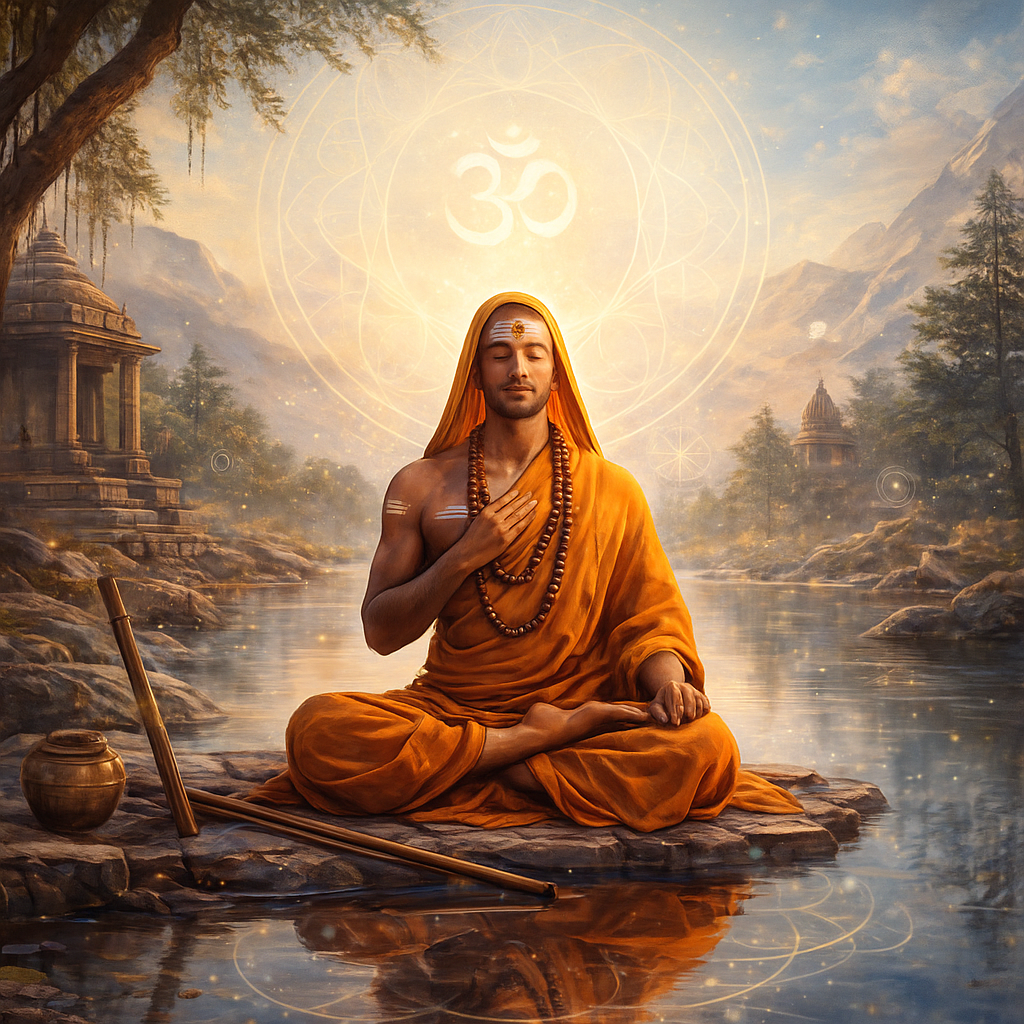
Overview
Adi Śankaracharya (c. 788–820 CE) was an Indian philosopher, theologian, and spiritual reformer who revitalized Hinduism and systematized Advaita Vedanta—the nondualistic school of thought teaching that the individual soul (Atman) and the ultimate reality (Brahman) are one. Through his writings, debates, and monastic institutions, he emphasized knowledge, discernment, and meditation as pathways to liberation. His legacy remains a cornerstone of Indian philosophy and global spiritual inquiry.
Historical Background
Birth and Early Life
- Born in Kalady, Kerala, India
- Demonstrated exceptional intellect and spiritual inclination as a child
- Became a monk at a young age, seeking deeper philosophical truth
Pilgrimage and Scholarly Journey
- Traveled across India engaging scholars, ascetics, and spiritual leaders
- Aimed to unify diverse philosophical traditions under a nondual framework
- Gained recognition for clarity, logic, and spiritual realization
Core Teachings and Philosophy
Advaita Vedanta – Nondualism
- Brahman is the only absolute reality—unchanging, infinite, and eternal
- The individual self (Atman) is not separate from Brahman
- Perceived separation arises from ignorance (Avidyā)
Māyā – The Illusion of Separation
- The world of multiplicity appears real but is transitory and conditioned
- Māyā veils true understanding, creating ego and suffering
- Realization dissolves illusion, revealing oneness
Liberation (Moksha)
- Achieved through Jnana Yoga—the path of knowledge
- Involves inquiry, self-awareness, discrimination, and meditation
- Liberation is recognizing one’s identity as pure consciousness
Major Works
Commentaries (Bhashyas)
- Brahma Sutra Bhashya — foundational Advaita text
- Commentaries on principal Upanishads and the Bhagavad Gita
- Clarified philosophical language and spiritual interpretation
Independent Works
- Vivekachudamani — “Crest Jewel of Discrimination”
- Upadesa Sahasri — instructional text on self-realization
- Hymns and devotional poetry blending intellect and devotion
Monastic and Cultural Influence
Establishment of Monastic Orders
- Founded four major monasteries (mathas) in India—north, south, east, and west
- Appointed disciples to preserve and transmit Advaita Vedanta
- Strengthened spiritual education, ritual continuity, and philosophical training
Revival of Hindu Tradition
- Countered ritual excesses, nihilistic philosophies, and sectarian divides
- Affirmed unity beneath diverse deities and practices
- Integrated devotion, ethics, and reasoning into spiritual life
Methods of Spiritual Inquiry
Neti Neti — “Not This, Not That”
- Analytical method of removing false identifications
- Leads the seeker toward awareness of pure consciousness
Śravana, Manana, Nididhyāsana
- Listening to teachings
- Reflecting on them intellectually
- Deep contemplative meditation to realize truth
Metaphysical and Esoteric Perspectives
Consciousness as the Ultimate Reality
- Brahman is awareness itself—unborn, boundless, indivisible
- The universe exists within consciousness, not outside it
Unity Beyond Religion
- Nondual truth applies to all beings and spiritual paths
- Divine essence pervades all life, forms, and experiences
Legacy and Global Influence
Enduring Impact
- Foundation of modern Hindu philosophy and spiritual discourse
- Influenced yoga, psychology, meditation, and interfaith dialogue
- Studied by scholars, seekers, and mystics worldwide
Modern Relevance
- Provides tools for addressing suffering, identity, and existential inquiry
- Offers a framework for inner peace, clarity, and compassion
Key Symbols and Associations
Spiritual Symbolism
Four Monastic Centers: preservation of wisdom in all directions
Om (AUM): primordial vibration and universal consciousness
Lotus: purity, transcendence, awakened awareness
Flame or light: illumination through self-knowledge