
Overview
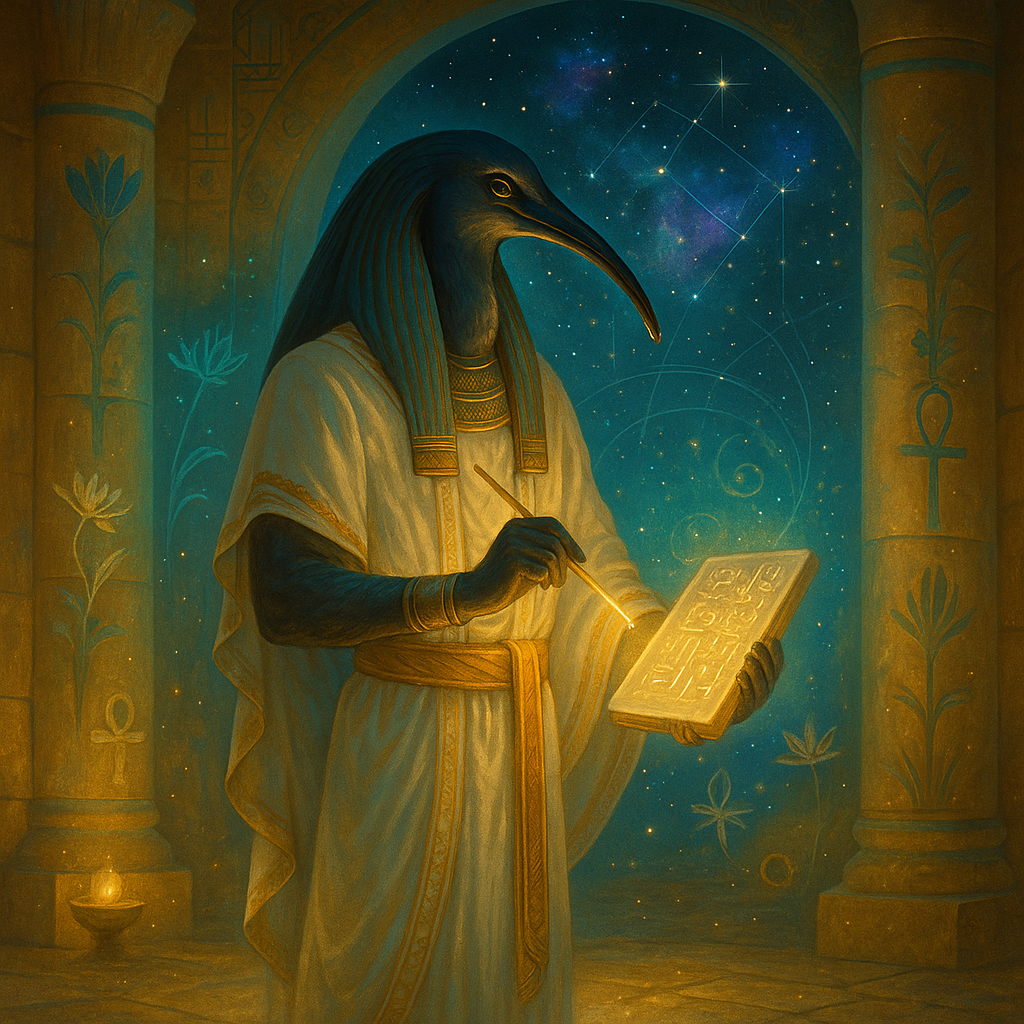
Thoth is an ancient Egyptian deity associated with writing, knowledge, mathematics, magic, timekeeping, and divine wisdom. Often depicted as an ibis-headed or baboon deity, he served as scribe of the gods and guardian of sacred records. Revered for thousands of years, Thoth became a symbol of intellectual illumination, spiritual learning, and cosmic balance—later inspiring Hellenistic, Hermetic, and esoteric traditions worldwide.
Historical and Mythological Background
Origins in Ancient Egypt
- Worship traced as early as the Pre-Dynastic period
- Honored primarily in Hermopolis, a major intellectual and religious center
- Viewed as a mediator between order (Ma’at) and chaos
Role in Egyptian Religion
- Maintained the functioning of the universe through knowledge and speech
- Assisted Ra, the sun god, on his nightly journey through the underworld
- Participated in the judgment of the dead, recording outcomes of the Weighing of the Heart ritual
Attributes and Divine Functions
Scribe of the Gods
- Inventor and patron of writing, hieroglyphs, and literature
- Recorder of divine laws, cosmic events, and spiritual truths
- Associated with scholarship, accounting, astronomy, and governance
Lord of Time and Cycles
- Credited with structuring the calendar and calculating lunar phases
- Regarded as custodian of cosmic order, rhythm, and eternal recurrence
Master of Magic and Transformation
- Patron of ritual, alchemy, spellwork, and sacred knowledge
- Seen as a divine healer and restorer of balance
Thoth in Art and Symbolism
Iconography
- Ibis-headed man: intellect, precision, spiritual observation
- Baboon: sacred witness, lunar wisdom, reflective awareness
- Writing palette and reed pen: transmission of knowledge and truth
- Crescent moon: timekeeping, intuition, hidden realms
Symbolic Meaning
- Embodiment of reason guided by spiritual awareness
- Bridge between physical and metaphysical realities
Texts and Esoteric Traditions
Ancient Egyptian Writings
- Revered as the author or divine source of temple inscriptions, ceremonial texts, and mythic wisdom
- Inspired priestly education, ritual scripts, and magical formulae
Hermetic Influence
- Later merged with the Greek god Hermes to form Hermes Trismegistus
- Credited—symbolically—with the Emerald Tablet and Corpus Hermeticum
- Became foundational to Hermeticism, alchemy, and Western esotericism
Philosophical and Spiritual Interpretations
Keeper of Universal Knowledge
- Represents inner knowing, intuitive intelligence, and enlightened communication
- Encourages seekers to pursue truth beyond appearances
Mediator of Polarity
- Balances logic and intuition, masculine and feminine, matter and spirit
- Embodies equilibrium necessary for spiritual evolution
Archetype of the Teacher
- Guide to initiates, scribes, magicians, and philosophers
- Symbol of mentorship, learning, and disciplined inquiry
Cultural Legacy and Global Influence
Ancient World Impact
- Honored by scholars, architects, healers, priests, and astronomers
- Influenced Egyptian governance, education, and ritual life
Later Traditions
- Respected in Gnostic, Hermetic, alchemical, Rosicrucian, and occult teachings
- Continues to inspire modern spirituality, metaphysics, and consciousness studies
Modern Relevance
- Represents sacred wisdom in personal transformation and inner awakening
- Invoked as a symbol of clarity, memory, insight, and intentional speech
- Guides holistic understanding of science, mysticism, and divine order
Key Symbols and Associations
Spiritual Symbolism
- Ibis: adaptability, precision, sacred awareness
- Writing tablet: knowledge preserved and transmitted
- Feather of Ma’at: truth, justice, cosmic balance
- Moon and stars: cycles, intuition, hidden wisdom
Thoth endures as a timeless guardian of intellect, spirit, and sacred memory—reminding humanity that wisdom is not merely accumulated knowledge, but the harmonious integration of truth, clarity, humility, and divine insight.