
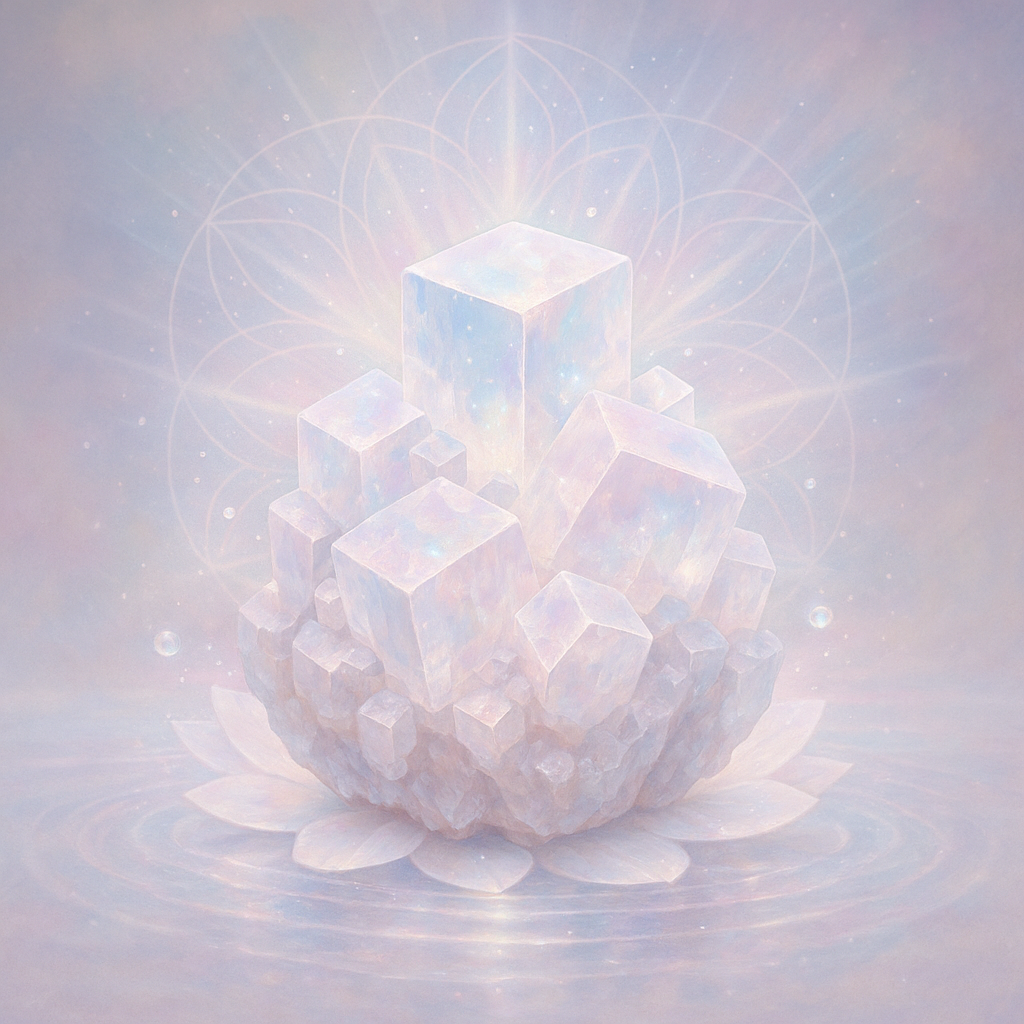
Overview
Halite, commonly known as rock salt, is a naturally occurring form of sodium chloride (NaCl). Its cubic crystals are typically colorless to white but can also be blue, pink, yellow, or orange due to impurities. Halite is essential both as a mineral resource and in holistic circles, where it is prized for its cleansing and purifying properties.
Physical Properties
- Chemical Formula: NaCl (Sodium Chloride)
- Color: Colorless, white, blue, pink, yellow, orange, red (often depending on mineral inclusions)
- Hardness: 2–2.5 on the Mohs scale (very soft)
- Crystal System: Isometric (cubic crystals are most common)
- Luster: Vitreous (glassy)
- Transparency: Transparent to translucent
- Taste: Salty (edible, but only pure, uncontaminated specimens)
- Solubility: Water-soluble; dissolves easily
- Common Sources: United States, Poland, Germany, United Kingdom, China, India, Pakistan (notably the Himalayan region), Canada
Historical & Industrial Significance
Halite has been essential to humanity for thousands of years, not just as a seasoning and preservative but also as a vital mineral resource for industry. Salt’s role in preserving food and supporting life led it to be called “white gold” in ancient times. Major salt deposits are mined for culinary, chemical, and de-icing uses worldwide.
Metaphysical Properties
Halite is revered in metaphysical and holistic practices as a powerful cleanser and purifier. It is thought to absorb negativity, dissolve energetic blockages, and bring clarity and freshness to spaces and individuals. Pink halite, in particular, is said to enhance emotional healing and self-love.
Key Associations:
- Chakras: Crown, Heart (especially pink halite)
- Element: Water, Earth
- Vibration: Purifying, clearing, uplifting
Healing & Spiritual Uses
- Cleansing & Purification: Halite absorbs negative energies from people and environments, making it an excellent stone for space clearing and aura cleansing.
- Emotional Healing: Pink and blue varieties support emotional release, self-acceptance, and calming of anxiety.
- Clarity & Insight: Facilitates mental clarity, fresh perspectives, and decision-making.
- Harmony & Balance: Supports balance on all levels—physical, emotional, and energetic.
- Protection: Used to create protective boundaries and energetic shields, especially in ritual or spiritual work.
- Physical Well-being: In holistic wellness, halite baths (salt baths) are popular for detoxification, relaxation, and skin health.
Practical Applications
- Salt Lamps: Carved from large halite crystals (especially Himalayan pink salt), believed to cleanse air and promote a peaceful environment.
- Bath Salts: Used in baths for energetic and physical cleansing and relaxation.
- Meditation & Ritual: Placed in meditation or healing spaces to purify energy and support intention work.
- Cooking & Food Preservation: Pure halite is used as table salt and for preserving foods.
Care & Cleansing
- Cleaning: Halite is highly water-soluble. Never soak; clean only with a dry or very lightly damp cloth. Avoid humid environments.
- Energetic Cleansing: Halite is self-clearing but can be refreshed with sound, moonlight, or intention.
Notable Varieties
- Pink Halite: Emotional healing, love, heart chakra support (found in California, Pakistan)
- Himalayan Salt: Ranges from white to deep pink; used in lamps, cooking, and baths
- Blue Halite: Rarer; supports clarity and deeper meditation
Correspondences
- Affirmation: “I am clear, cleansed, and open to new energy and insight.”
- Zodiac Signs: Pisces, Aquarius
- Planetary Association: Moon
Cautions
Halite is very soft and dissolves in water. Keep away from moisture and humidity, and do not place directly on skin for long periods if sensitive. Only food-grade halite should be consumed. Some colored specimens may contain mineral impurities—do not ingest unless confirmed safe.
Further Reading
- “The Crystal Bible” by Judy Hall
- “Rocks & Minerals” by DK Smithsonian
- Mindat.org entry on Halite
See Also:
Pink Halite | Himalayan Salt | Cleansing Stones | Crystal Grids