
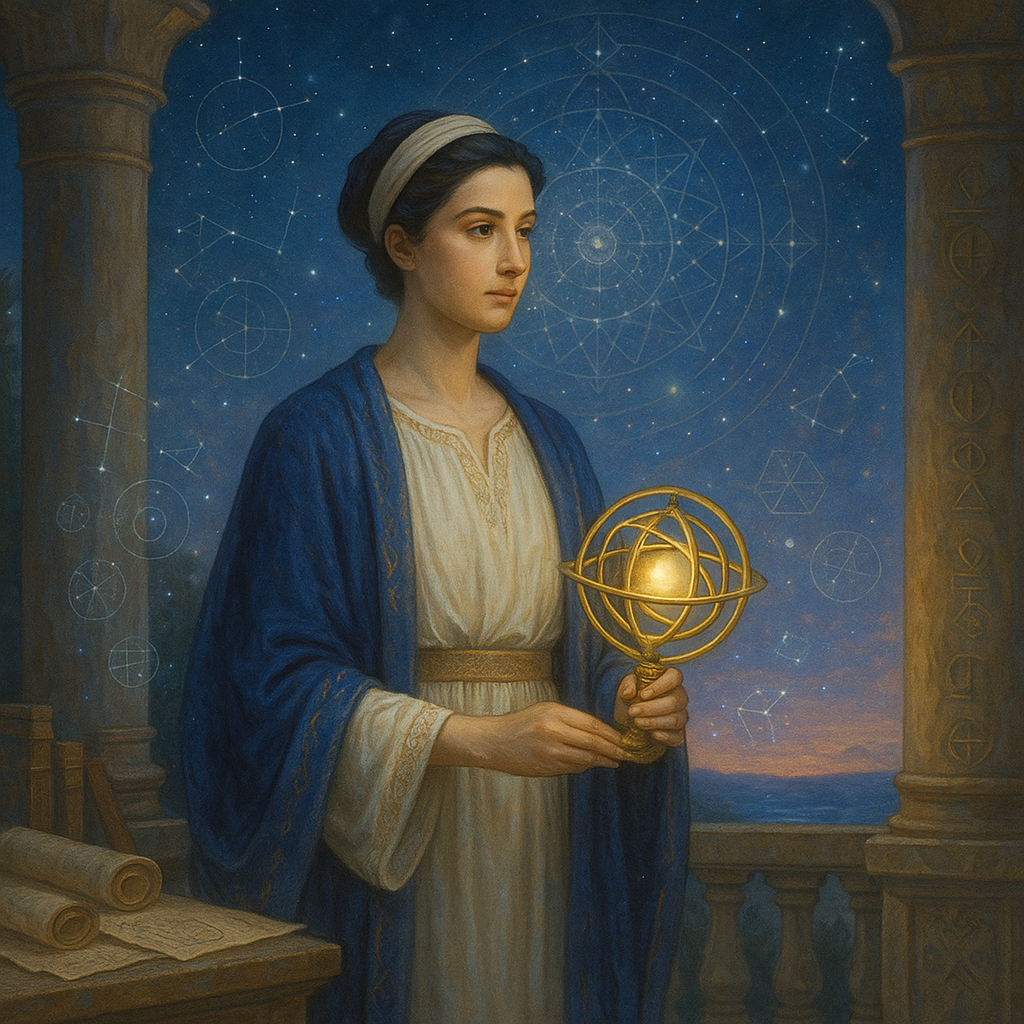
Overview
Hypatia of Alexandria (c. 355–415 CE) was a renowned mathematician, astronomer, and Neoplatonic philosopher whose intellect, leadership, and teachings made her one of the most influential women of the ancient world. Celebrated for her scholarship, clarity of thought, and devotion to reason, she became a symbol of intellectual freedom, scientific inquiry, and women’s empowerment throughout history.
Historical Background
Early Life and Education
- Born in Alexandria, Egypt—then a major center of learning
- Daughter of Theon, a mathematician and scholar at the Library of Alexandria
- Received advanced training in mathematics, astronomy, philosophy, and rhetoric
- Raised to pursue knowledge beyond societal expectations for women
Intellectual Environment
- Lived during a politically and religiously turbulent era
- Alexandria was a crossroads of Greek philosophy, Egyptian culture, and emerging Christianity
- Classical scholarship faced increasing political and ideological pressure
Academic and Scientific Contributions
Mathematics and Geometry
- Expanded upon Euclidean and Diophantine mathematical traditions
- Edited and possibly improved foundational works such as Euclid’s Elements and Ptolemy’s Almagest
- Contributed to the preservation of classical mathematical knowledge
Astronomy and Scientific Instruments
- Taught planetary motion and celestial harmonics
- Helped design or refine instruments like the astrolabe and hydrometer
- Used observational tools to study the structure of the cosmos
Neoplatonic Philosophy
- Headed the Neoplatonic school in Alexandria
- Taught that the universe is ordered, rational, and governed by divine harmony
- Encouraged students to pursue virtue, logic, and inner wisdom
Teaching and Public Influence
Revered Educator
- Attracted diverse students—pagans, Christians, and political leaders
- Known for clarity, compassion, eloquence, and intellectual rigor
- Taught publicly and privately, embodying accessible education
Civic Advisor
- Respected by Alexandria’s ruling elite
- Offered philosophical counsel to government officials
- Advocated for reasoned dialogue and social harmony
Conflict and Martyrdom
Political and Religious Tensions
- Alexandria experienced growing conflict between secular authorities and rising Christian power
- Hypatia’s influence, independence, and philosophical ideals threatened extremist factions
Her Death
- Murdered by a Christian mob in 415 CE
- Seen as a tragic turning point representing the suppression of classical learning
- Her death symbolized the struggle between ignorance and enlightenment
Legacy and Historical Significance
Guardian of Ancient Knowledge
- Preserved scientific and philosophical texts that may have otherwise been lost
- Served as a bridge between classical Greek science and later scholarly traditions
Feminist and Humanist Icon
- Celebrated as a pioneering woman in STEM fields
- Represents intellectual courage, autonomy, and equality
- Inspires modern movements for women’s education and academic freedom
Influence on Western Thought
- Revered by Enlightenment thinkers as a martyr for reason
- Central figure in literature, philosophy, art, and historical studies
- Continues to spark conversations on tolerance, progress, and free inquiry
Metaphysical and Symbolic Interpretations
Archetype of Wisdom
- Seen as the embodiment of Sophia—divine feminine intelligence
- Represents truth-seeking beyond dogma and societal constraints
Symbol of Cosmic Inquiry
- Astronomy and mathematics reflect her devotion to universal order
- Encourages exploring the cosmos as a pathway to understanding self and spirit
Key Symbols and Associations
Spiritual and Intellectual Symbolism
- Astrolabe: celestial knowledge and scientific curiosity
- Scrolls or codices: preservation of wisdom and scholarship
- Lamp or torch: illumination of the mind and pursuit of truth
- Circle or geometric figures: harmony, logic, and cosmic unity
Hypatia of Alexandria remains a timeless monument to human intellect—an inspiring reminder that truth, compassion, and reason can transcend eras, institutions, and limitations. Her life invites us to honor knowledge, defend inquiry, and courageously seek understanding.