
Overview
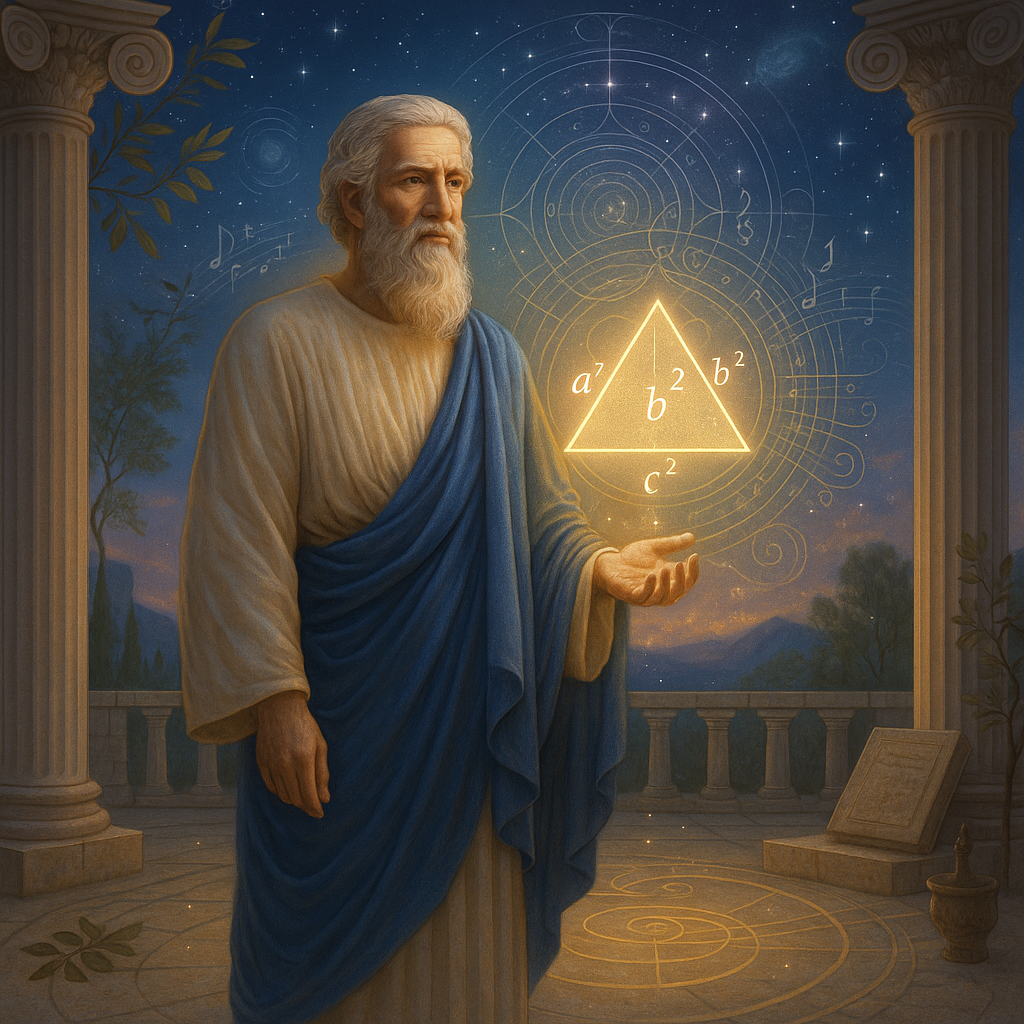
Pythagoras of Samos (c. 570–495 BCE) was an ancient Greek philosopher, mathematician, mystic, and spiritual teacher whose ideas laid foundations for Western science, philosophy, and esoteric thought. Best known for the Pythagorean Theorem, he also viewed mathematics, music, and nature as expressions of a divine and harmonious cosmic order. His teachings blended rational inquiry with spiritual transformation, influencing philosophy, religion, and metaphysics for millennia.
Historical Background
Early Life and Travels
- Born on the island of Samos in the Aegean Sea
- Traveled through Egypt, Mesopotamia, and possibly India to study mathematics, astronomy, and sacred traditions
- Exposed to priestly, mystical, and philosophical knowledge across cultures
Founding of the Pythagorean School
- Established a philosophical community in Croton, southern Italy
- Functioned as both a spiritual brotherhood and academic institution
- Emphasized ethical living, intellectual discipline, and inner purification
Mathematical and Scientific Contributions
The Pythagorean Theorem
- Demonstrated the relationship a2+b2=c2a^2 + b^2 = c^2a2+b2=c2 in right-angled triangles
- Became a foundational principle of geometry and mathematical reasoning
Numbers as Sacred Reality
- Believed numbers structure existence, not merely describe it
- Saw numerical relationships as keys to understanding the universe
Harmony of the Spheres
- Proposed that planetary motion produces inaudible cosmic music
- Reflected belief in mathematical harmony governing the cosmos
Philosophy and Spiritual Teachings
The Soul and Reincarnation
- Taught that the soul is immortal and undergoes multiple lifetimes
- Ethical behavior influences spiritual evolution and future embodiment
The Pursuit of Virtue
- Encouraged self-discipline, kindness, moderation, and truthfulness
- Philosophy was a lived practice, not only an intellectual pursuit
Way of Life
- Advocated vegetarianism, contemplative silence, and communal living
- Believed purification of body and mind leads to spiritual clarity
Mysticism, Esotericism, and Symbolism
Mathematics as Divine Language
- Numbers reveal hidden patterns of creation
- Geometry reflects cosmic intelligence and spiritual structure
Symbolic Teachings
- The tetractys (triangular figure of 10 dots) represented creation, harmony, and unity
- Sacred geometry used to contemplate universal order
Influence and Legacy
Impact on Western Philosophy
- Inspired Plato, Aristotle, Neoplatonists, and later European thinkers
- Helped shape metaphysics, ethics, epistemology, and cosmology
Influence on Science and Mathematics
- Contributed to geometry, acoustics, astronomy, and mathematical theory
- Supported the idea that nature can be understood through measurement and ratio
Esoteric and Spiritual Traditions
- Revered within Hermeticism, Rosicrucianism, Theosophy, and mystery schools
- Associated with numerology, sacred geometry, and mystical cosmology
Metaphysical and Holistic Perspectives
Unity of All Things
- The cosmos is an interconnected, living organism
- Human beings participate in universal harmony
Inner Transformation Through Knowledge
- Understanding reality requires both logic and spiritual awareness
- Wisdom integrates reason, intuition, and ethical action
Key Symbols and Associations
Spiritual Symbolism
- Tetractys: harmony, creation, divine order
- Triangle: balance, stability, spiritual ascent
- Lyre or musical intervals: mathematical harmony in sound
- Number One and Ten: unity and completion
Pythagoras remains a timeless figure whose legacy bridges science and spirituality. His life and teachings invite seekers to explore reality through harmony, reason, ethical living, and awe for the mathematical beauty woven into existence.