
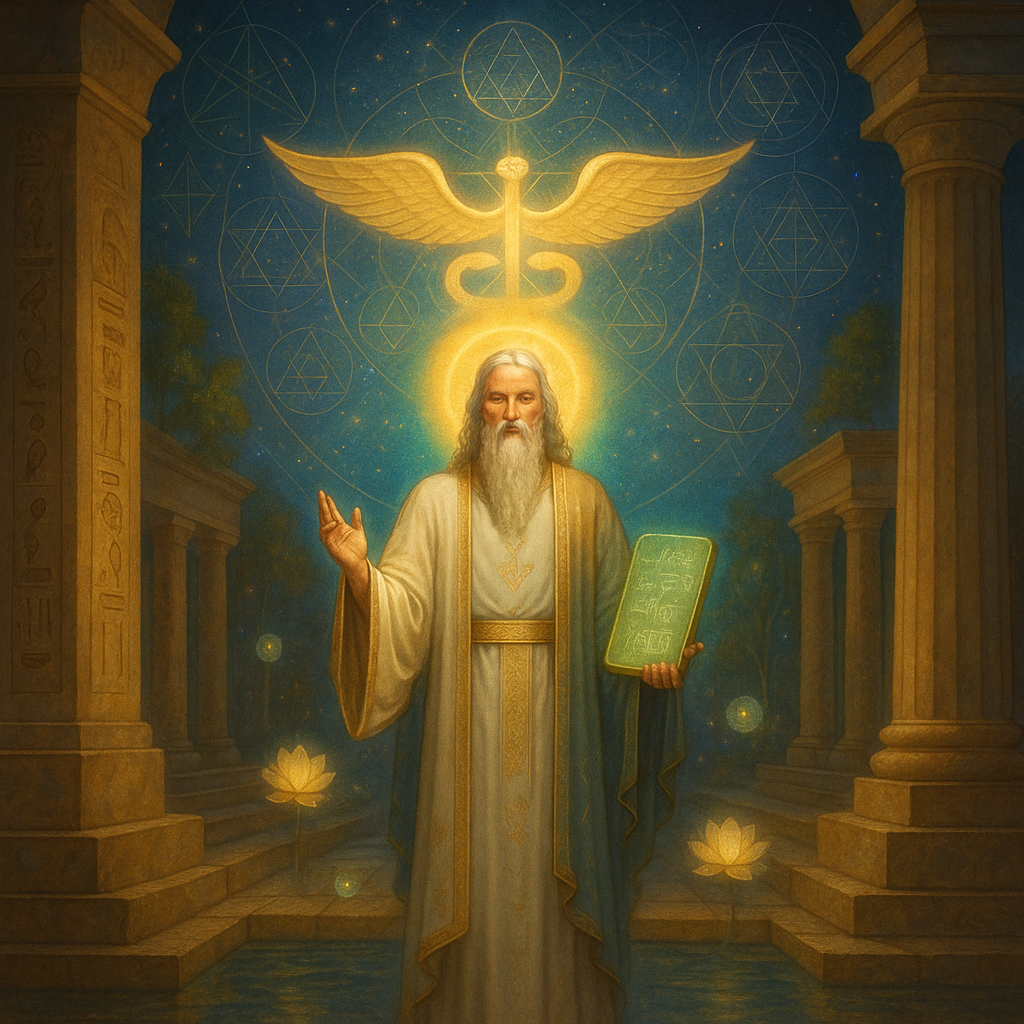
Overview
Hermes Trismegistus—meaning “Thrice-Great Hermes”—is a legendary figure revered as the foundational source of Hermeticism, an esoteric philosophical and spiritual tradition that bridges ancient Egyptian, Greek, and mystical thought. Often associated with both the Greek god Hermes and the Egyptian god Thoth, he is credited with revealing divine knowledge about creation, consciousness, alchemy, and the hidden laws governing reality.
Historical and Mythological Origins
Cultural Synthesis
- Emerged during the Hellenistic period, when Greek and Egyptian cultures blended
- Represents the merging of Hermes (messenger, intellect, language) and Thoth (wisdom, writing, magic)
- Became a symbol of universal knowledge and spiritual authority
Debated Historical Identity
- Not considered a single historical person
- May represent a lineage of priest-philosophers or an archetype of enlightened wisdom
- Writings attributed to him span centuries, suggesting multiple authors
The Hermetic Texts
The Corpus Hermeticum
- Central collection of philosophical dialogues on the nature of reality, divinity, and the soul
- Discusses creation, consciousness, spiritual transformation, and cosmic order
The Emerald Tablet
- Short but influential alchemical text containing the maxim: “As above, so below”
- Interpreted as a key to understanding unity between physical and spiritual realms
Additional Writings
- Asclepius, philosophical fragments, and later alchemical manuscripts
- Influenced Gnostic, mystical, and occult traditions for centuries
Core Hermetic Philosophy
The Divine Mind (Nous)
- All existence arises from a single, intelligent, creative consciousness
- Human beings can access this divine wisdom through inner awakening
The Unity of All Things
- Reality is interconnected, layered, and purposeful
- Spirit and matter reflect one another, not separate
As Above, So Below
- Macrocosm and microcosm mirror each other
- Universal laws apply across all dimensions of existence
The Seven Hermetic Principles
1. Mentalism
All is Mind—the universe originates from and exists within consciousness.
2. Correspondence
Patterns repeat across planes of reality—physical, mental, and spiritual.
3. Vibration
Everything moves, shifts, and vibrates at different frequencies.
4. Polarity
Opposites are extremes of the same essence, reconciled through understanding.
5. Rhythm
Cycles, seasons, and energetic tides govern unfolding experience.
6. Cause and Effect
Nothing is random—every action influences a greater whole.
7. Gender
Masculine and feminine energies exist in balance within all creation.
Hermeticism and Alchemy
Inner and Outer Transformation
- Alchemy viewed not just as metal transmutation, but spiritual refinement
- “Turning lead into gold” symbolizes elevating consciousness
Symbolic Language
- Uses metaphor, imagery, and encoded teachings
- Designed to protect wisdom from misuse and encourage personal revelation
Influence on Spiritual and Philosophical Traditions
Western Esoteric Lineage
- Inspired Gnosticism, Kabbalah, Neoplatonism, Rosicrucianism, and Renaissance magic
- Influenced early scientists, mystics, philosophers, and theologians
Modern Relevance
- Foundational to contemporary metaphysics, occult studies, New Thought, and spiritual psychology
- Continues to inspire seekers exploring universal consciousness and sacred science
Metaphysical and Esoteric Interpretations
Hermes as an Enlightened Master
- Seen as a guide to inner alchemy and self-realization
- Represents the awakening of divine wisdom within humanity
Symbol of Universal Knowledge
- Embodies the integration of science, spirituality, philosophy, and magic
- Encourages experiential understanding rather than dogma
Key Symbols and Associations
Spiritual Symbolism
- Caduceus: balance, healing, cosmic communication
- Emerald Tablet: encoded universal wisdom
- Ibis or Winged Messenger: divine knowledge descending to humanity
- Sun and Moon: unity of polarity and illumination
Hermes Trismegistus remains a timeless archetype of sacred wisdom—bridging heaven and earth, intellect and intuition, science and mysticism. His teachings invite seekers to look inward, question reality, and remember the divine intelligence woven through all existence.