
Overview
Angkor Wat, located in present-day Cambodia, is the largest religious monument in the world and one of the greatest architectural and spiritual masterpieces ever created. Built in the early 12th century by King Suryavarman II, Angkor Wat was originally dedicated to the Hindu god Vishnu before later becoming a major Buddhist sanctuary.
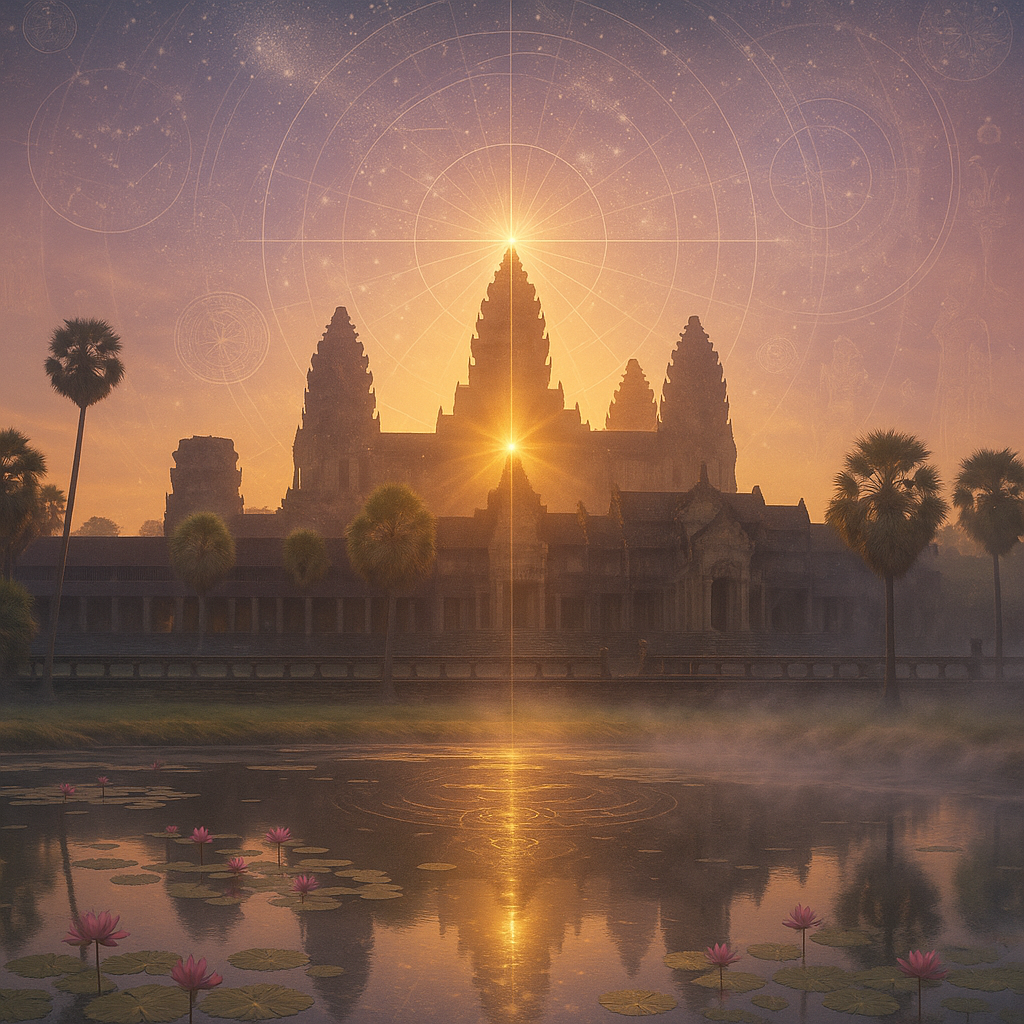
Renowned for its massive scale, intricate carvings, and precise astronomical alignments, Angkor Wat is not only a temple—it is a cosmological diagram encoded in stone. Its design reflects the structure of the universe as envisioned in Hindu cosmology: the sacred mountain Mount Meru, the cosmic ocean, the heavens, and the cycles of time.
In metaphysical and esoteric traditions, Angkor Wat is viewed as a portal of cosmic energy, a living mandala, and a multidimensional map connecting the earthly realm to the divine.
Spiritual and Cultural Significance
Representation of the Universe in Architecture
- Entire temple symbolizes the Hindu cosmos
- Central towers represent Mount Meru, the axis of all realms
- Enclosing galleries and moats reflect cosmic oceans
Temple as a Solar Calendar and Sacred Observatory
- Aligns with solstices and equinoxes
- Encodes celestial cycles and yuga (cosmic ages) concepts
Bridge Between Heaven and Earth
- Designed as a spiritual journey inward and upward
- Represents the soul’s ascent toward enlightenment
Historical and Architectural Context
Construction and Purpose
Built by King Suryavarman II (1113–1150 CE)
- Centerpiece of the Khmer Empire
- Dedicated to Vishnu, unusual for Khmer kings (traditionally devotees of Shiva)
Transformation into a Buddhist Sanctuary
- Became a major center of Theravada Buddhism in later centuries
- Preserved continuously, unlike many Angkor temples
Architectural Design
Massive Scale
- Covers 400 acres
- Central temple rising 65 meters above ground
Three-Tiered Structure
- Five iconic towers arranged in a quincunx
- Represents cosmic and spiritual ascent
Intricate Bas-Reliefs
- Depict gods, celestial beings, mythic battles, and cosmic cycles
- Over half a mile of continuous carvings
Cosmic Symbolism and Esoteric Meaning
1. Mount Meru and the Axis of the Universe
Central Towers as Cosmic Pillars
- Represent Mount Meru—the sacred mountain at the center of all realms
- Five peaks symbolize the five cosmic directions
- Serve as the energetic axis connecting Earth, heavens, and underworld
Vertical Ascension
- Journey through the temple mimics spiritual ascent from human realm to divine realm
2. Moats and Enclosing Walls: Cosmic Ocean and Boundaries
Moat as the Primordial Waters
- Symbolizes the cosmic ocean surrounding Mount Meru
- Reflects creation myths and the churning of the ocean of milk
Outer Walls
- Represent the edges of the universe
- Define sacred space and separation of worldly and divine realms
3. Solar and Astronomical Alignments
Sunrise Alignment on Equinoxes
- Sun rises precisely over the central tower
- Creates luminous pathway through the temple corridor
Solar Calendar Encoded in Architecture
- Temple width corresponds to the number of days in the solar year
- Markers and bas-reliefs track equinoxes, solstices, and lunar cycles
Stellar Symbolism
- Some theories suggest alignments with the constellation Draco or Orion
- Reflects cosmic order mirrored on Earth
4. Vishnu and Cosmic Preservation
Dedication to Vishnu
- Symbolizes preservation, order, and stability
- Aligns with the temple’s astronomical precision
Vishnu’s Cosmic Forms
- Bas-reliefs show Vishnu as cosmic sustainer, time keeper, and universal protector
5. The Churning of the Ocean of Milk
Central Myth Carved into Gallery
- Devas (gods) and asuras (demons) churn the ocean to obtain the elixir of immortality
- Serpent Vasuki used as divine rope
- Represents:
- Cycles of creation and dissolution
- Spiritual struggle
- Alchemical transformation of consciousness
Symbol of Human Inner Work
- Represents purification and the quest for enlightenment
Sacred Geometry and Esoteric Architecture
Mandala in Stone
Ground Plan as Cosmic Diagram
- Temple layout mirrors sacred mandala structure
- Reflects harmony between divine proportions and earthly space
Golden Ratio and Mathematical Precision
- Measurements use sacred numerical patterns
- Supports energetically coherent and resonant architecture
Axial Pathways and Initiation Journey
West-to-East Orientation
- Unusual for Khmer temples (most face east)
- Symbolizes journey from death (west) to rebirth (east)
Labyrinthine Corridors
- Encourage contemplative walking, symbolic inner journey
- Layers represent cycles of the cosmos and levels of consciousness
Spiritual Practices and Ritual Use
Hindu Rituals in the Early Period
Offerings, Fire Ceremonies, and Temple Dances
- Sacred rites performed to honor Vishnu
- Priests worked with solar light entering key chambers
Pilgrimage Pathways
- Devotees followed clockwise circumambulation
Buddhist Use in Later Centuries
Meditation and Monastic Life
- Temple became a center for Buddhist teaching
- Reliefs of apsaras (celestial dancers) used as meditative symbols
Integration of Hindu and Buddhist Cosmology
- Cosmic symbolism transcended religious boundaries
Influence and Legacy
Khmer Empire
- Angkor Wat served as a political, religious, and cosmic center
- Symbol of divine kingship: king as earthly counterpart to cosmic order
Southeast Asian Spiritual Architecture
- Inspired temples in Thailand, Laos, Myanmar, and beyond
- Spread of mandala-based temple design
Global Esoteric Influence
Studied for:
- Sacred geometry
- Solar alignment
- Archetypal cosmic symbolism
- Energetic architecture
Modern Spiritual Pilgrimage
- Visitors experience temple as a site of alignment, meditation, and consciousness expansion
Cautions and Considerations
Respect for Active Religious Site
- Angkor Wat remains sacred to Cambodians
- Visitors should act with reverence and cultural sensitivity
Separation of Myth, Astronomy, and Mysticism
- Many cosmic interpretations are symbolic or esoteric, not literal
- Distinguish between archaeological evidence and metaphysical insight
Preservation Challenges
- Tourism and environmental changes pose risks to the site
Key Associations
Energetic Correspondence
- Element: Ether / Fire (solar energy)
- Themes: Cosmic order, enlightenment, divine harmony, spiritual ascent
Spiritual Archetypes
- Cosmic preserver (Vishnu)
- World mountain (Meru)
- Celestial dancer (Apsara)
- Divine architect
Angkor Wat and Its Cosmic Symbolism embody humanity’s ancient quest to mirror the universe in sacred architecture. Through precise geometry, solar alignment, mythic storytelling, and spiritual design, the temple stands as a living model of the cosmos—inviting all who enter to walk the path from the outer world to the inner divine.