
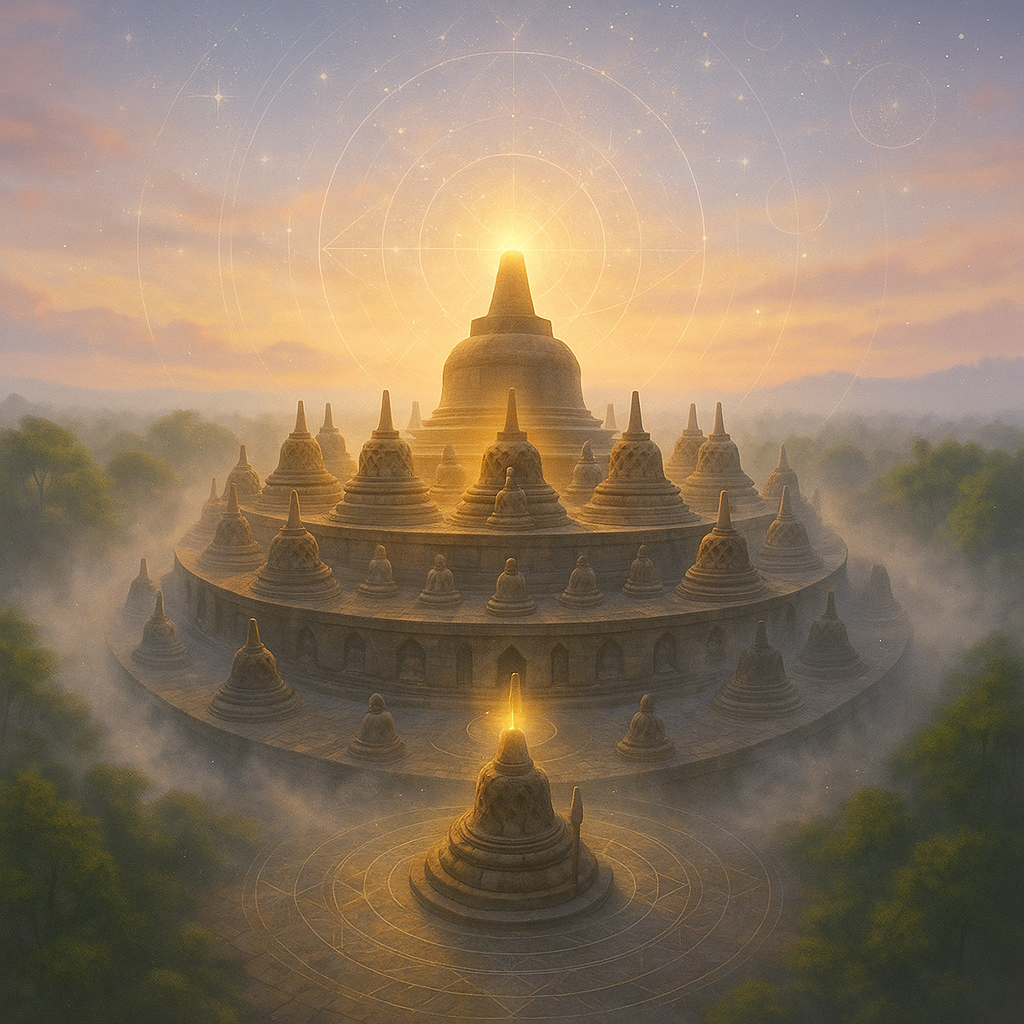
Overview
Borobudur is the world’s largest Buddhist monument and one of humanity’s most profound expressions of spiritual architecture. Located in Central Java, Indonesia, and built during the 8th–9th centuries under the Sailendra dynasty, Borobudur is a massive stone mandala—a three-dimensional representation of Buddhist cosmology, spiritual ascent, and enlightened mind.
Constructed from more than 2 million stone blocks, Borobudur is not a temple in the traditional sense but a pilgrimage monument designed to guide practitioners on a symbolic journey from the world of desire, through the realm of form, and finally into the formless state of enlightenment.
Its layout, carvings, and ascending terraces function as a sacred map linking the physical world to spiritual realization. Today, Borobudur stands not only as an architectural wonder but as a powerful energetic and symbolic portal for meditation, pilgrimage, and spiritual reflection.
Spiritual and Cultural Significance
A Three-Dimensional Mandala
- Entire structure represents a mandala: a diagram of the cosmos and awakened mind
- Designed for circumambulation—movement through sacred geometry
Path of Enlightenment
- Pilgrims ascend from lower realms to higher realms
- Represents purification of mind, transformation of consciousness, and ultimate liberation
Integration of Buddhist Philosophy
- Encodes teachings from Mahayana Buddhism
- Illustrates the journey of the bodhisattva
Historical and Architectural Context
Construction Period and Cultural Influence
8th–9th Century CE
- Built during the height of the Sailendra dynasty
- Influenced by Gupta-style Indian Buddhism but uniquely Javanese
Abandonment and Rediscovery
- Likely abandoned after volcanic eruptions and religious shifts
- Rediscovered in the 19th century by Europeans
- Restored extensively in the 20th century
Architectural Form
Massive Stone Monument
- Over 55,000 square meters of carved volcanic stone
- No internal chambers—entire monument is symbolic
Pyramid-Mandala Layout
- Nine stacked platforms:
- 6 square terraces
- 3 circular terraces
- Topped by a central stupa representing ultimate enlightenment
The Sacred Mandala Structure
1. Three Realms of Buddhist Cosmology
Borobudur is divided into three ascending realms, mirroring Mahayana Buddhist teachings:
Kamadhatu – The Realm of Desire
- Lowest level
- Depicts the human world bound by craving and karma
- Features 160 reliefs illustrating cause and effect
Rupadhatu – The Realm of Form
- Middle terraces
- Square levels representing disciplined spiritual practice
- Contains galleries with 1,300+ narrative reliefs
Arupadhatu – The Formless Realm
- Upper circular terraces
- Transition from geometric rigidity to perfect openness
- Emptiness, purity, and boundless awareness
This symbolic ascent reflects the pilgrim’s inner transformation.
2. The Central Stupa: Symbol of Enlightenment
Inner Emptiness
- Hollow interior represents shunyata, the formless essence of enlightenment
- No image inside—symbolizes the ineffable nature of awakening
Radiating Geometry
- Stupa sits at the center of the cosmic mandala
- Represents the Bodhi Mind, cosmic unity, and ultimate liberation
Symbolism and Esoteric Meaning
1. Mandala as a Map of the Universe
Cosmic Structure
- Represents Buddhist conception of the cosmos
- Square base symbolizes Earth
- Circular top symbolizes Heaven
Vertical Axis
- Central stupa marks the cosmic axis, connecting earth to the divine
2. Pilgrimage as Initiation
Circumambulation (Pradakshina)
- Pilgrims walk clockwise around each level
- Path spirals upward like kundalini rising
Embodied Meditation
- Movement, sight, breath, and silence harmonize
- Journey reflects inner purification and awakening
3. Guardian and Teaching Reliefs
Iconography of the Buddha
- Over 500 Buddha statues in mudras conveying specific teachings
- Each terrace emphasizes different aspects of spiritual mastery
Narrative Panels
- Reliefs portray Jataka tales, sutras, and bodhisattva paths
- Teach ethical living, compassion, and spiritual wisdom
4. Stupas as Symbolic Portals
Perforated Lattice Stupas
- 72 stupas surround the central stupa
- Each contains a seated Buddha
- Symbolize the permeable veil between form and formlessness
Astronomical and Geomantic Alignments
Solar Alignment
Orientation to Cardinal Directions
- Entire monument aligned with sunrise and sunset
- Reflects cosmic harmony and natural order
Geomancy and Earth Energy
Built on a Sacred Axis
- Positioned between two rivers and volcanic mountains
- Represents balance of cosmic and earthly forces
- Some view Borobudur as an energetic node or Earth chakra
Spiritual Practices at Borobudur
Buddhist Pilgrimage
Vesak Celebrations
- Thousands gather yearly on full moon in May
- Commemorates birth, enlightenment, and passing of the Buddha
Meditation and Mindfulness
- Stupas and terraces provide sacred space for contemplation
- Geometry supports deep stillness and energetic alignment
Chanting and Ritual Offerings
- Integrate movement, sound, and devotion
- Honor the Buddhas and bodhisattvas of all realms
Influence on Later Traditions
Southeast Asian Buddhism
- Borobudur influenced temple design in Java, Bali, and Southeast Asia
- Integrated with local animist and ancestral traditions
Global Symbolism
Study of Mandalas
- Inspires modern mandala art and meditation
- Used in psychological and spiritual practices
Sacred Geometry
- Cited as an example of harmonic architecture aligned with consciousness
Cautions and Considerations
Preservation Challenges
- Weathering, erosion, and tourism affect the structure
- UNESCO and Indonesian authorities limit access for protection
Cultural Sensitivity
- Borobudur is an active spiritual site
- Visitors should act with reverence and respect
Distinguishing Symbolism from Historical Evidence
- Mandala interpretation widely accepted
- Esoteric readings enrich but may not reflect original intent in full detail
Key Associations
Energetic Correspondence
- Element: Air / Ether
- Themes: Enlightenment, cosmic order, spiritual ascent, pure awareness
Spiritual Archetypes
- Bodhisattva
- Cosmic Buddha
- Mandala guardian
- Pilgrim seeker
Borobudur and Its Sacred Mandala Design stand as a lasting testament to humanity’s ability to encode cosmic wisdom into architecture. As a living mandala and spiritual map, Borobudur invites all who walk its ascending pathways to experience the journey from the world of form to the pure, boundless awareness of enlightenment.